How to create a sentimental diamond with DNA infusion

Imagine holding a diamond that carries the actual carbon of someone you love. Not a symbolic gesture, not a photograph set in silver, but a certified, brilliant-cut stone grown from their very essence. That is what sentimental diamond creation makes possible, and for those who want their legacy jewelry to mean something beyond its price tag, it is a profoundly different kind of investment. Sentimental diamonds are lab-grown from ashes, hair, or DNA samples, transforming the deeply personal into the permanently beautiful. This guide walks you through every step, from understanding the science to holding your finished stone.
Table of Contents
Key Takeaways
Point | Details |
DNA-based personalization | Sentimental diamonds can be created from ashes, hair, or DNA, offering unique legacy jewelry. |
Rigorous, secure process | Creating a memorial diamond involves several precise steps, with certifications ensuring authenticity. |
Bespoke customization | You can choose size, shape, color, and even combine multiple personal samples for deeper meaning. |
Emotional significance | These diamonds serve as tangible, meaningful heirlooms that celebrate and preserve a loved one’s legacy. |
Ethical and transparent | Leading labs offer chain-of-custody documentation, full ethical oversight, and real diamond grading. |
Understanding sentimental diamond creation
The foundation of a sentimental diamond lies in a technology called High Pressure High Temperature, or HPHT, growth. This is the same method used to grow many premium lab diamonds, except the carbon feedstock comes from a profoundly personal source rather than an industrial one. The result is a stone that is chemically, optically, and structurally identical to any mined diamond you would find at a leading auction house.
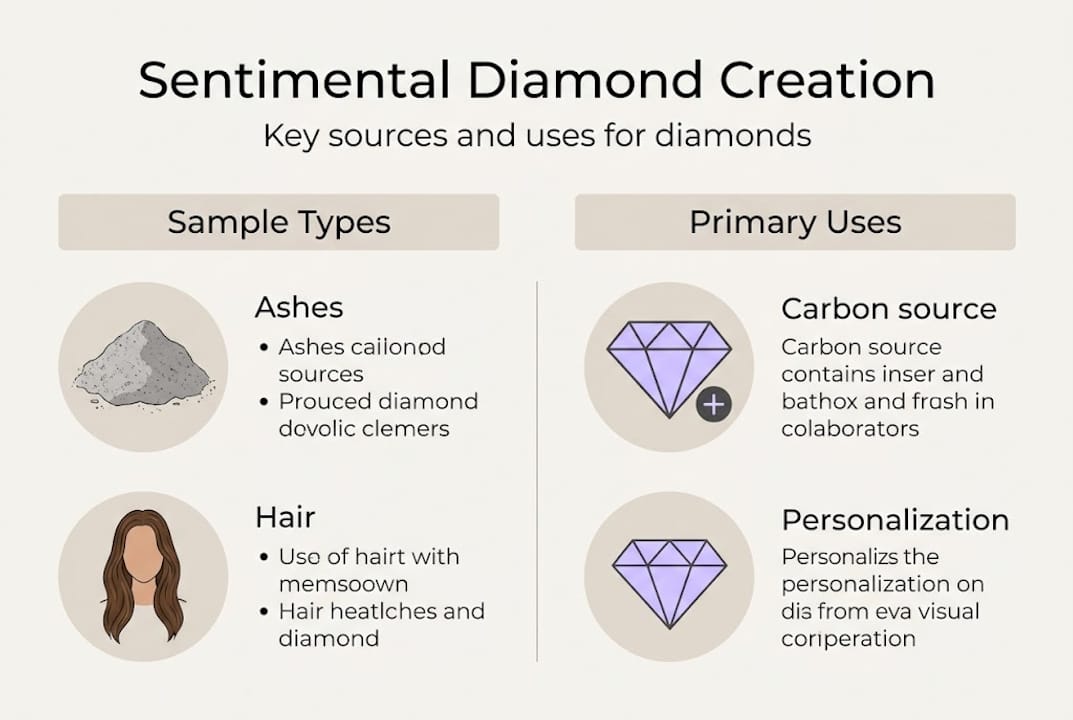
Personalized memorial gems draw from several possible carbon sources, and each one carries its own significance:
Human ashes: Approximately 100 grams of cremated remains provide enough carbon after purification for a single stone.
Hair: As little as 5 to 10 grams of hair, collected from brushes, lockets, or a final haircut, can supply sufficient carbon.
DNA samples: Extracted from cheek swabs, nails, or hair follicles, DNA samples are used for symbolic identification, connecting the stone to a specific individual even when other carbon sources are used.
Pet fur or ashes: Yes, beloved animals can be memorialized just as meaningfully as people.
Multi-family combinations: Mixing samples from multiple family members to create a single stone is possible, making it a true family heirloom.
The variety matters because different sample types allow for edge cases like multiple diamonds from one individual, color variation through trace elements, and symbolic DNA infusion with ethical handling at every stage.
Source type | Quantity required | Primary use |
Cremated ashes | ~100 grams | Carbon source |
Hair | 5 to 10 grams | Carbon source |
DNA sample (nails/swab) | Small sample | Symbolic identification |
Pet fur/ashes | Similar to above | Carbon or identification |
Pro Tip: The DNA infused into your diamond does not literally remain in the crystal lattice. Carbon atoms form the diamond structure, while the DNA serves as a symbolic identifier tying the stone to a specific person. The emotional meaning is real and intentional, but the science is about carbon, not genetics.
Memorial jewelry diamonds have evolved from simple cremation keepsakes into sophisticated heirloom pieces that rival the finest bespoke jewelry available anywhere. Understanding this distinction matters before you begin.
Essential requirements and preparation
With the basics in mind, it is time to prepare. Let’s review what you will need before starting this transformative journey.
Before a single sample leaves your hands, preparation determines the quality, authenticity, and emotional integrity of your finished diamond. This stage is where many clients either get it right or struggle later.
Sample collection essentials:
Ashes: Work with your cremation provider to set aside at least 100 grams, stored in a sealed, labeled container with accompanying documentation.
Hair: Collect from multiple locations if one source is limited. Root-attached strands are ideal. Store in a paper envelope, never plastic, to prevent moisture buildup.
DNA (nails or cheek swabs): Clip fresh nails and seal immediately, or use a sterile swab kit provided by your chosen lab.
The stepwise personalized memorial jewels process begins with a chain-of-custody document, which is your written record of every person who handles your sample from the moment it leaves you to the moment it enters the growth chamber. Reputable providers maintain this rigorously.
Required documentation typically includes:
Proof of relationship to the individual (for human samples)
Signed consent or estate authorization
Chain-of-custody transfer logs
Shipping labels with tracking and insurance
What to look for in a provider:
DNA infusion capability with demonstrable traceability
Independent certification partnerships (GIA or IGI)
Physical lab access or real-time photo documentation
Clear pricing with no hidden post-production fees
Secure sample collection kits, individual sample handling, optional GIA/IGI certification, and jewelry setting as part of one cohesive service
Consideration | Why it matters |
Chain-of-custody | Ensures sample integrity throughout |
Certification partnership | Validates diamond quality independently |
Lab transparency | Confirms ethical, personalized handling |
Custom design timing | Avoids delays after the stone is ready |
Pro Tip: Decide on your preferred cut, color, carat, and setting before submitting your sample. Custom settings often require lead time, and having your preferences locked in avoids a frustrating wait after your diamond has been grown and cut.
Step-by-step: Creating your sentimental diamond
Once you have your materials and plan, you are ready for the transformative step-by-step process.
This is where science and sentiment converge. The creation of a sentimental diamond is methodical, precise, and deeply supervised. Here is exactly what happens at each stage.
Sample submission: You ship your sample using the provider’s secure, insured kit. A chain-of-custody log begins the moment it arrives.
Carbon extraction and purification: The sample is processed to isolate carbon. For ashes, this means removing silicates and other non-carbon materials. For hair, the keratin is broken down to release usable carbon.
Graphite conversion: The purified carbon is converted into graphite, the crystalline precursor that the HPHT chamber will transform into a diamond. This stage requires precision because impurities at this point affect the final stone’s color and clarity.
HPHT crystal growth: The graphite, combined with a diamond seed crystal, is placed in the growth press. Under pressures exceeding 1.5 million pounds per square inch and temperatures above 2,700 degrees Fahrenheit, carbon crystallizes into diamond over a period of 2 to 12 weeks depending on desired size and clarity.
Cutting and polishing: A master cutter shapes the rough crystal into your chosen cut, whether round brilliant, cushion, emerald, or a completely custom form. Polishing brings out the optical brilliance.
Optional certification: The stone is submitted to GIA or IGI for independent grading. This report documents the 4Cs (cut, color, clarity, carat) and confirms its lab-grown origin.
Jewelry setting: Your certified stone is set into your chosen piece, whether a solitaire ring, pendant, cuff, or multi-stone arrangement.
“Every transfer of your sample is documented with date, handler, and location. This chain-of-custody record is your proof that the diamond you receive was grown from your sample and no one else’s. Insist on it in writing before you commit to any provider.”
The full HPHT process can take between 4 and 11 months from sample submission to jewelry delivery. Growth alone spans 2 to 12 weeks, while cutting, certification, and setting account for the rest. Plan your timeline accordingly, especially if the piece is intended for a significant occasion.
Detailed steps from collection through setting confirm that every reputable provider follows a standardized sequence, though the level of client communication and transparency during the process varies significantly. Prioritize providers who give you regular, documented updates.
Customization options and personalization
But how can you make your diamond reflect your family’s story? Customization is the key.
A sentimental diamond does not need to look like any other diamond. The entire point is that it should look, feel, and mean something uniquely yours. For high net worth clients, the customization possibilities are both broad and deeply intentional.
Color options: Natural HPHT diamonds grown from personal carbon often produce a yellow tone due to nitrogen present in biological material. Additional treatments can create:
Blue or blue-green stones via boron introduction during growth
Pink stones through post-growth irradiation and annealing
Colorless or near-colorless stones with specialized purification steps
Color results from trace elements, with yellows and warm tones being natural outcomes, while blue, green, and pink hues require deliberate treatment. Multiple diamonds can be created from a single sample, and pet fur is just as usable as human hair.
Cut and iconography: Beyond standard shapes, some labs offer custom cuts that incorporate symbolic geometry, family crests rendered in gold around the setting, or engraved inscriptions on the girdle of the stone.
Combining samples: Perhaps the most powerful customization is creating a single stone that incorporates carbon from multiple family members. A husband and wife, a parent and child, or three generations of a family can be woven into one piece.
Customization type | Emotional impact | Availability |
Color treatment | Ties stone to personality or memory | Most providers |
Multi-sample blending | Multi-generational legacy | Select providers |
Custom cut | Unique visual identity | Specialist labs |
Engraved inscription | Personal message in the stone | Most providers |
Pet fur inclusion | Memorial for beloved animals | Many providers |
For high net worth individuals, heirlooms can integrate multi-generational DNA, bespoke cuts and colors, and settings symbolizing personal traits, with ethical providers offering lab visits and full documentation at every stage.
Pro Tip: Request full photo and video documentation of every step from graphite formation through to the first cut on your rough stone. This archive becomes part of the diamond’s provenance record and adds irreplaceable sentimental depth to the piece’s story.
Creative memorial ideas run the spectrum from understated solitaire pendants to elaborate multi-stone pieces set with diamonds from different family members, each one representing a distinct voice in a shared story.
Verification, certification, and receiving your diamond
Once your custom diamond is created, the final steps guarantee authenticity and emotional value.
Receiving a sentimental diamond is not simply unboxing fine jewelry. It is the culmination of months of careful, supervised work and the physical realization of a deeply personal decision. The final stage should be treated with the same rigor as the growth process itself.
Certification options:
GIA (Gemological Institute of America): The gold standard for diamond grading globally. A GIA report covers cut, color, clarity, and carat, and identifies the stone as lab-grown.
IGI (International Gemological Institute): Widely accepted and increasingly preferred for lab-grown diamonds, with detailed grading reports.
Laser inscription: A microscopic code engraved on the girdle of the stone links it to its grading report. This is your permanent, tamper-proof identifier.
Chain-of-custody documentation: Separate from gemological certification, this is your provider’s internal record proving sample integrity from receipt through delivery.
Gem labs can certify quality and authenticity but cannot verify the biological origin of the carbon. That assurance comes entirely from your provider’s chain-of-custody records, which is why choosing a transparent provider from the start is not optional.
What to expect at delivery:
Detailed grading report (GIA or IGI)
Chain-of-custody summary document
Certificate of origin from your provider
Any remaining sample material (most reputable labs return unused portions)
Pricing for sentimental diamonds ranges from $1,000 to over $10,000 depending on carat size and color treatment, with optional GIA/IGI certification and financing plans available from leading providers. The full journey from submission to delivery can span up to 11 months, so building that window into your planning is essential for milestone events.
A modern legacy: Our advanced take on sentimental diamond creation
Most guides focus on the technical sequence and stop there. What they miss is that the greatest value in a sentimental diamond is not in its carat weight or GIA grade. It is in the story the piece carries forward across generations.
Symbolic personalization matters more than literal DNA infusion. The ethical, low-energy nature of the process actively supports grief, and the artistry of how the story is framed around the stone is where legacy is truly built.
The biggest mistake high net worth clients make is treating this like a premium product purchase. They optimize for carat size and color grade while neglecting the documentation, storytelling, and honoring loved ones through jewelry that transform a beautiful stone into an irreplaceable heirloom. Fifty years from now, your grandchildren will not remember the clarity grade. They will remember the story you embedded in that stone.
Our strong recommendation is to partner with labs that offer real-time updates, ethical transparency, and a creative consultation that treats the design process as narrative work, not just product specification. The chain-of-custody document is your emotional guarantee, not just a legal one.
Pro Tip: Commission a written provenance narrative alongside your diamond, documenting who the stone is for, whose carbon it carries, and the intention behind every design choice. Seal it with the grading report in a keepsake archive.
Create your own one-of-a-kind legacy with us
If you are ready to make memories everlasting, discover how our luxury team brings your vision to life.
At Shinlabz, we specialize in custom jewelry design services that transform your most personal materials into certified, brilliant diamonds. Our entire DNA infusion process takes just two hours, meaning your sample is handled with extraordinary precision and respect in a fraction of the time other labs require. From the first consultation to the final setting, we document every stage, maintain strict chain-of-custody protocols, and collaborate with you on design choices that reflect exactly what this piece should mean. Ready to begin? Book a consultation with our team today and take the first step toward creating something that will outlast everything else.
Frequently asked questions
What biological materials can be used to create a sentimental diamond?
Ashes, hair, and DNA samples can all serve as carbon sources for making a sentimental diamond, with pet fur being an equally valid option for animal memorials.
How long does the sentimental diamond creation process take?
The full process spans 4 to 11 months, covering sample submission, carbon growth, cutting, certification, and final jewelry setting.
Can I make multiple diamonds from one sample?
Yes, multiple diamonds can be created from a single hair or ashes sample, and it is also possible to combine family members’ or pets’ samples into one stone.
Are sentimental diamonds real diamonds?
Absolutely. Lab-grown sentimental diamonds are real diamonds in every sense and can be independently certified by GIA or IGI, carrying the same optical and chemical properties as mined stones.
Does the DNA remain in the completed diamond?
No. DNA is used for symbolic personalization and identification purposes, but only the carbon atoms form the final crystal structure of the diamond.
Recommended
Comments