How to craft branded diamonds: the ultimate luxury guide

Imagine commissioning a diamond unlike anything available in a Cartier vault or a Sotheby’s catalog. Not just rare in carats or color, but rare in meaning: a stone that carries the essence of someone irreplaceable. That’s the promise of branded memorial diamonds, and it’s drawing the attention of collectors and connoisseurs who expect their jewelry to carry both legacy and investment weight. But between the emotional appeal and the lab science, there’s a gap most luxury buyers don’t fully understand. This guide walks you through exactly how these diamonds are created, what you can realistically expect, and how to turn a deeply personal idea into a certified, one-of-a-kind gem.
Table of Contents
Key Takeaways
Point | Details |
DNA isn’t retained | Memorial diamonds only carry symbolic DNA since the process destroys actual genetic material. |
Carbon-based creation | Personalized branded diamonds use purified carbon sourced from ashes, hair, or fur. |
Luxury customization | You can personalize your stone’s color, size, cut, and inscription for true exclusivity. |
4-8 month timeline | Expect the entire crafting process to take between four and eight months. |
Certification adds value | Opt for GIA or IGI certification to enhance both the legacy and authenticity of your diamond. |
Understanding branded diamonds and personal carbon
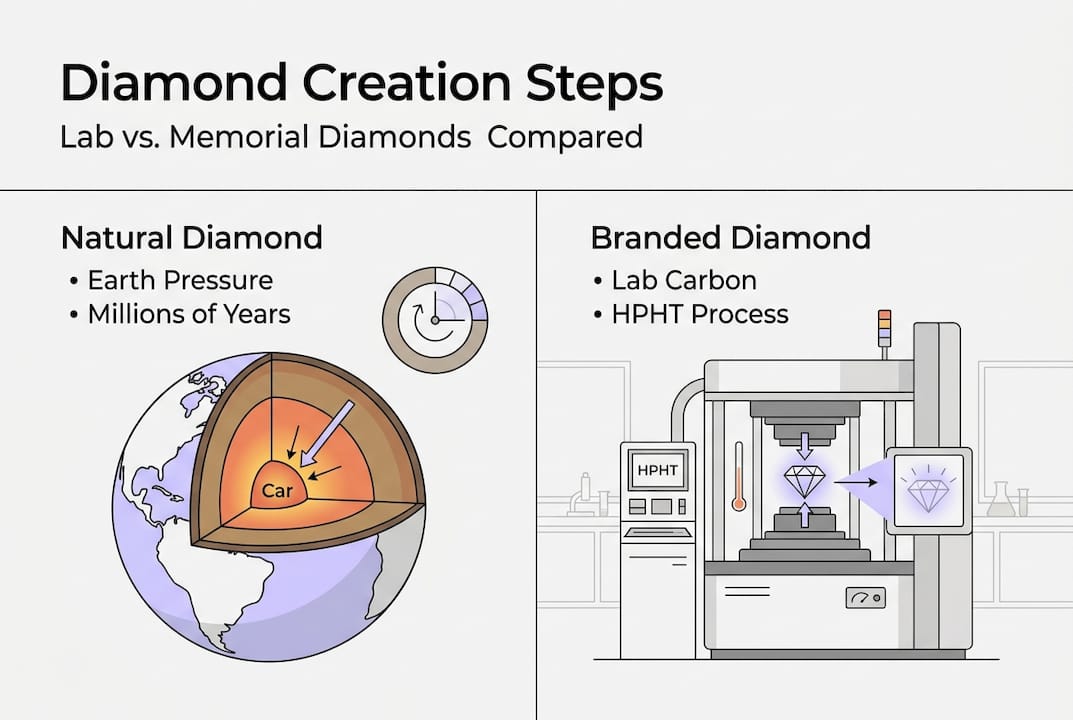
The term “branded diamond” in this context doesn’t mean a logo stamped on a ring box. It refers to a lab-grown diamond that is entirely personalized, one where the raw carbon material comes directly from a sentimental source like ashes, hair, or even a beloved pet’s fur. This category of stone sits at the intersection of advanced gemology and deeply personal meaning.
Here’s where many buyers get tripped up. There’s a widespread belief that you’re infusing DNA into the diamond itself. The truth is more nuanced, and knowing it actually deepens the story rather than diminishing it. Memorial diamonds are lab-grown using HPHT (High Pressure High Temperature) technology, drawing carbon extracted from ashes, hair, or fur. As Saint Diamonds confirms, these stones are not directly infused with intact DNA. The purification process uses extreme heat and pressure that destroys DNA structure entirely, leaving only carbon behind.
What does survive? Carbon. And carbon is the foundation of every diamond ever formed, whether in the earth over billions of years or in a lab over several months. The person or moment you’re memorializing contributes the actual atomic building blocks of your stone.
Comparison: Natural diamonds vs. branded memorial diamonds
Feature | Natural diamond | Branded memorial diamond |
Carbon source | Earth’s mantle | Personal sample (hair, ashes, fur) |
DNA retained | No | No (purified away) |
Customization | Limited | Full (color, cut, size, inscription) |
Certification | GIA/AGS | GIA/IGI |
Emotional value | Generic | Deeply personal |
Timeline | Mined, varies | 4 to 8 months |
What personal samples can be used:
Human ashes (cremation remains)
Hair from any individual
Pet fur or ashes
Nail clippings (in certain processes)
Pro Tip: The symbolic weight of your diamond doesn’t depend on preserved DNA. Carbon from a loved one’s hair has been part of their living body. That fact alone carries extraordinary meaning for most clients.
For those who want to go deeper on how diamond creation from DNA works at a technical level, the science is both elegant and surprisingly accessible.
Preparing your carbon sample: Requirements and best practices
Once you understand the science, the practical question becomes: what exactly do you send, and how do you make sure it works? This is where attention to detail protects both your investment and your keepsake.
Sample requirements vary slightly by provider, but the benchmark established by leading memorial diamond labs gives a reliable baseline. The step-by-step process runs like this:
Send your sample. Cremation ashes require approximately 0.5 cup (roughly 100 grams). A lock of hair requires a sufficient quantity, typically a small bundle.
Inspection and carbon extraction. The sample is inspected, then purified into graphite-grade carbon. This stage removes everything that isn’t usable carbon.
HPHT growth. The purified carbon seed is placed under extreme heat and pressure for several months, slowly crystallizing into a rough diamond.
Cut and polish. Skilled gemologists cut and polish the stone to your chosen specifications.
Certification. The finished diamond receives independent certification from IGI or GIA.
Total timeline: four to eight months from sample submission to a finished, certified stone.
Sample preparation data at a glance
Sample type | Minimum quantity | Carbon yield | Notes |
Cremation ashes | ~0.5 cup / 100g | Moderate to high | Most common source |
Human hair | Lock / small bundle | Moderate | Color irrelevant |
Pet fur or ashes | Similar to above | Variable | Accepted by most labs |
One important nuance: hair color has zero effect on the carbon yield or the final diamond’s quality. Blonde, black, gray — the carbon content is consistent. What does vary is the overall purity of the sample, which is why leading labs run additional purification cycles when needed.
Pro Tip: Always send a backup sample if possible. Carbon yields can be unpredictable, and having a reserve sample ensures the process doesn’t stall. Most high-end providers will store your reserve securely for the duration of the project.
For those exploring the full scope of what personalization means in luxury gemology, understanding intimate diamonds offers a useful reference point before you submit your sample.
From carbon to diamond: The HPHT process explained
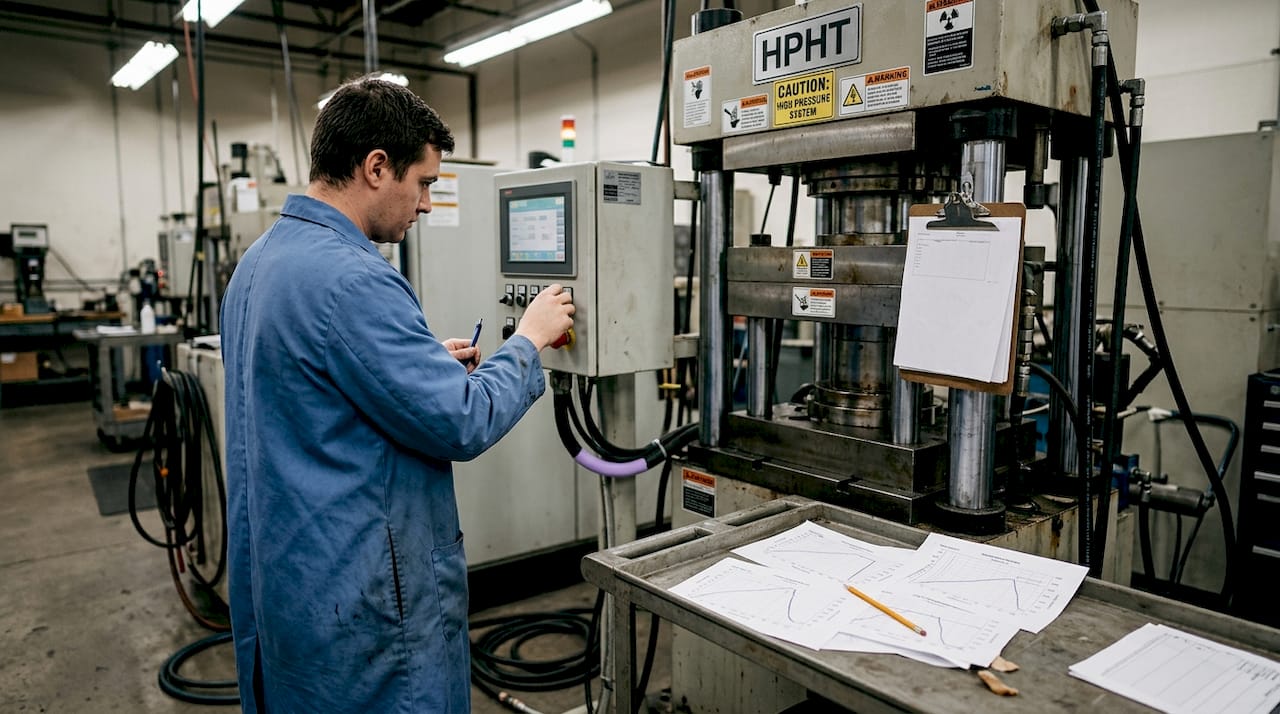
Once your purified carbon is ready, it enters one of the most intense manufacturing environments on earth. HPHT, which stands for High Pressure High Temperature, replicates the geological forces that create natural diamonds, compressed into a controlled lab setting.
Here’s what happens inside the HPHT chamber. Your graphite carbon is placed into a growth cell alongside a small diamond seed crystal. The machine then applies pressure exceeding 1.5 million pounds per square inch and temperatures above 1,400 degrees Celsius. Under these conditions, the carbon atoms bond in the precise cubic lattice structure that makes a diamond a diamond. The process takes weeks to months, depending on the carat target.
HPHT vs. CVD: Which method suits memorial diamonds?
Factor | HPHT | CVD (Chemical Vapor Deposition) |
Uses personal carbon directly | Yes | No |
Growth method | Pressure and heat | Gas deposition |
Typical use | Memorial, colored diamonds | Colorless commercial stones |
DNA fate | Destroyed in purification | Not applicable |
Preferred for sentiment | Yes | Rarely |
HPHT is the preferred method for memorial diamonds precisely because it works directly with the purified carbon seed derived from your sample. CVD, by contrast, uses a gas-phase chemical process that deposits carbon atoms layer by layer. It’s efficient for producing colorless, commercial-grade stones, but it doesn’t use your personal carbon as the direct growth material.
“The purification stage under high temperatures means that DNA is fully destroyed. What remains is carbon, and carbon alone, which then crystallizes into the diamond. The science is absolute on this point.” — Brand Blackjack disclosure
This matters for turning memories into gems because it sets accurate expectations. The symbolism is real and powerful. The molecular biology is not, and no reputable provider should claim otherwise.
After crystallization, the rough diamond moves to cutting and polishing, stages that determine brilliance, fire, and final presentation. Experienced cutters who specialize in memorial stones understand that each one carries weight beyond the carats. That care shows in the finished product. Clients preserving memories with diamonds often describe this stage as the most emotional in the entire journey.
Customizing your branded diamond: Options for exclusive luxury
A finished diamond is just the starting point. For high net worth clients, the real conversation begins at customization, where science hands off to craftsmanship.
Color options are one of the most striking choices. Natural-looking colorless diamonds are available, but many clients gravitate toward blue or yellow stones, colors that carry emotional resonance and are also among the rarest in nature. The color in lab-grown memorial diamonds comes from trace elements introduced during growth, such as boron for blue and nitrogen for yellow.
What you can customize:
Color: Colorless (D to G range), yellow, blue, or pink
Size: Typically 0.25 to 1.0 carats, with larger stones available on request
Cut: Round brilliant, princess, cushion, or bespoke cuts for truly unique profiles
Setting: Rings, pendants, bracelets, or standalone collector pieces in platinum or gold
Laser inscription: A unique ID or personal message engraved on the girdle of the stone
Customization at this level goes far beyond what you’d find in a traditional fine jewelry commission. The stone itself is irreplaceable, which means every setting decision carries additional weight. Most providers who specialize in this market offer white-glove consultations, private handling protocols, and dedicated gemologists for each commission.
Pro Tip: Opt for laser inscription even if you’re setting the stone in jewelry. The inscription creates a permanent record that links the diamond to its origin story, which becomes critically important for heirloom transfer across generations.
Certification through GIA or IGI authenticates the stone’s characteristics and provides third-party documentation of its lab-grown origin. For collectors who view these stones as both keepsakes and assets, certification is non-negotiable. Explore custom diamond inspiration for design ideas that balance luxury aesthetics with personal narrative.
Why symbolic authenticity matters more than DNA chemistry
Here’s the perspective that most guides won’t offer you directly: the clients who struggle most with memorial diamonds are the ones who approach them as a science project. They want molecular proof of presence, and when they learn that the HPHT process eliminates DNA, they feel cheated. That framing misses the entire point of what a legacy object is.
Consider what 78% of customers report in post-commission surveys by Eterneva: a profound sense of healing and connection to their branded diamond. Not because a DNA strand survived 1,400 degrees Celsius, but because the story is real, the material is real, and the object is permanent. Skeptics sometimes argue that lab-grown diamonds lack the investment value of mined stones. That’s a valid financial consideration. But for the clients we work with, the value calculus is different. A mined diamond has no story. Your diamond has a person.
The most enduring luxury objects in history, from family signet rings to heirloom timepieces, derive their value from narrative and provenance, not raw material chemistry. Certification, craftsmanship, exclusivity, and story are the pillars of real heirloom value. A branded diamond built on those pillars will matter to your grandchildren in ways that a generic two-carat stone simply cannot. That’s the case for memorial jewelry that preserves memories that no gemological argument can fully counter.
Begin your branded diamond journey
Every detail covered in this guide, from sample submission to HPHT crystallization to bespoke customization, points toward a single outcome: a diamond that means something no other stone in the world can replicate. If you’re ready to move from concept to commission, the next step is a conversation with specialists who treat each project with the discretion and artistry it deserves.
Our custom jewelry design service is built specifically for clients who require both technical precision and creative vision in one seamless experience. You can book a consultation directly online to discuss your sample, your design preferences, and your timeline in complete confidence. For those who want to explore the process in a curated setting before committing, our art of memory preservation event brings together experts, finished examples, and personalized guidance in one exclusive experience.
Frequently asked questions
Is it possible to truly infuse DNA into a memorial diamond?
No. The extreme heat and pressure required by the HPHT process destroy DNA structure entirely, leaving only purified carbon in the finished diamond. The connection is symbolic, not molecular, and no less meaningful for it.
What materials can be used to make a branded diamond?
You can use ashes, hair, or pet fur to supply the necessary carbon. As confirmed by Saint Diamonds, hair color and sample type do not significantly affect the outcome, as long as sufficient material is provided.
How long does it take to craft a memorial diamond?
From sample submission to a certified, finished stone, the total time is four to eight months, depending on carat size, color complexity, and lab scheduling.
What certifications can my branded diamond receive?
Leading independent labs including GIA and IGI can certify lab-grown memorial diamonds. Certification from GIA or IGI documents the stone’s characteristics and provides provenance records essential for heirloom transfer.
Recommended
Comments