Your exclusive diamond checklist: DNA tributes done right


When you decide to honor someone irreplaceable with a diamond grown from their own DNA, the stakes are unlike any other luxury purchase. You’re not simply acquiring a gemstone. You’re commissioning a permanent tribute, and every decision from vendor selection to certification carries real weight. The challenge is that this category sits at the intersection of fine jewelry, biotechnology, and deeply personal legacy planning. Most checklists online are written for casual buyers. This guide is built for you: someone who expects provenance, transparency, and flawless execution, and who wants a clear framework before committing to something this meaningful.
Table of Contents
Key Takeaways
Point | Details |
Insist on certification | Always select diamonds certified by GIA or IGI with full provenance and real images. |
Personalization adds lasting value | Creating a diamond from your DNA offers unmatched emotional significance beyond material value. |
Transparency ensures authenticity | Demand clear documentation, sample traceability, and a proven creation process for peace of mind. |
Review vendor track record | Choose only reputable providers with published reviews and direct communication throughout the process. |
The essentials of an exclusive diamond checklist
Before you even discuss DNA or personalization, the foundational standards for any exclusive diamond purchase apply. Think of these as the non-negotiables that protect both your investment and your peace of mind.
According to investment-grade jewelry standards, the bar for high-value diamond acquisition goes well beyond simply picking a size and shape. A diamond buying checklist for discerning buyers emphasizes certification from GIA or IGI as the absolute starting point, followed by cut quality, verified provenance, and documentation you can hold in your hands.
Here’s what your baseline checklist should include:
GIA or IGI certification on every stone, with a certificate number you can verify independently online
Cut quality prioritized above all other 4Cs, since cut determines brilliance more than any other factor
Documented provenance, including origin records and chain-of-custody paperwork
Real images and videos of the actual stone, not stock photography or renders
Vendor reputation, including verifiable client reviews, years in operation, and direct gemologist access
Resale and satisfaction policies in writing before you commit
One detail that separates elite vendors from the rest: the ability to speak directly with a credentialed gemologist, not just a sales representative. If a company can’t connect you with someone who can answer technical questions about inclusions, growth conditions, or color grading, that’s a signal worth heeding.
For deeper reading on sourcing standards, our expert diamond guides cover the full spectrum of what discerning buyers should expect at every stage.
Pro Tip: Always request the original documentation, not a photocopy or digital scan. Authentic certification paperwork has security features that copies won’t replicate. If a vendor hesitates, move on.
Personalized DNA and memorial diamond essentials
With the basics in place, let’s explore what happens when you opt for the ultimate in personalization: a diamond crafted from your DNA.
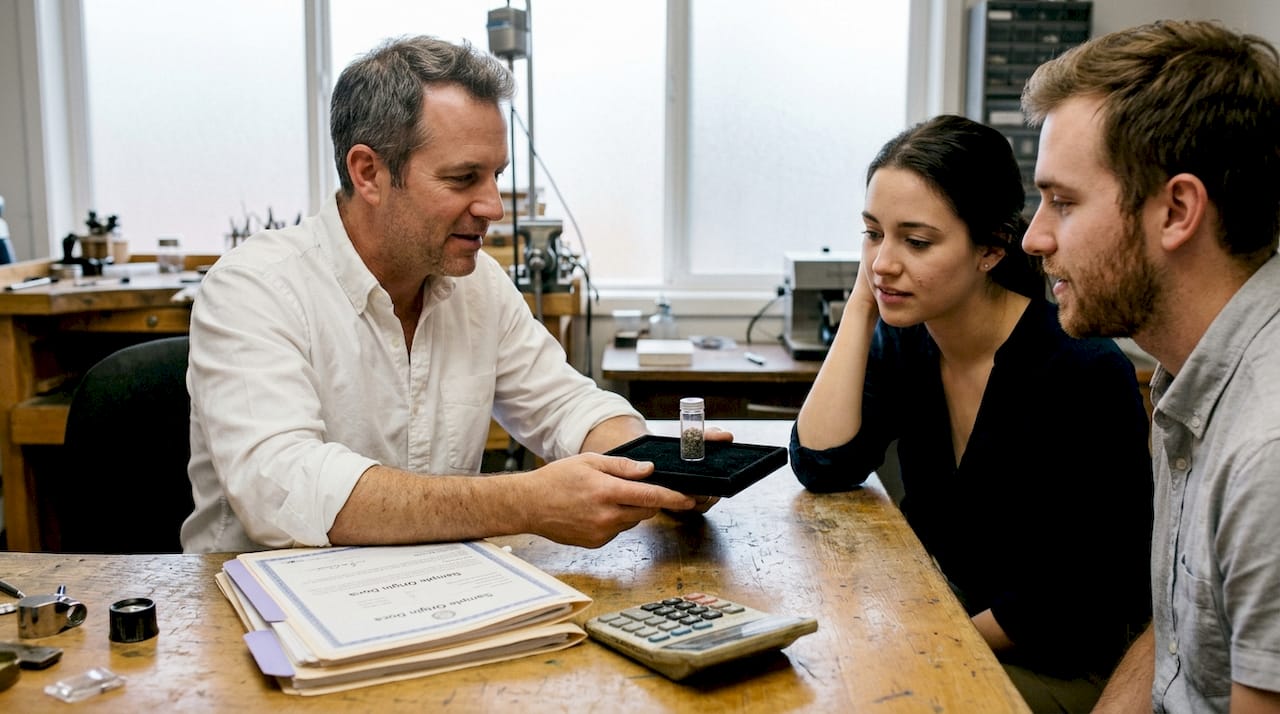
The process is more precise than most people realize. DNA memorial diamonds are lab-grown via the HPHT process, where carbon is extracted from hair or ashes at a yield of roughly 0.5 to 2%, purified to 99% or higher graphite purity, then grown under extreme heat and pressure before being cut and certified with full provenance documentation.
Here’s how the journey typically unfolds:
Sample submission: You provide hair, nails, or cremated ashes. A small amount is sufficient.
Carbon extraction and purification: The organic material is processed to isolate pure carbon, removing all other biological compounds.
HPHT growth: The purified carbon seed is placed in a high-pressure, high-temperature press where it crystallizes into a diamond over several months.
Quality assessment: The rough diamond is evaluated for color, clarity, and structural integrity.
Cutting and polishing: Master cutters shape the stone to maximize brilliance.
Certification and documentation: The finished diamond receives GIA or IGI certification alongside a full chain-of-custody report.
Delivery: The diamond arrives with all documentation, and optional laser inscription if requested.
The most important checklist item at this stage is individual handling. Your sample should never be mixed with another client’s material. Reputable providers offer traceability documentation at every stage, optional laser inscription with names and dates, and color customization through trace elements like boron for blue or nitrogen for yellow.
Pro Tip: Ask your vendor upfront whether they can provide photographic or video documentation of your diamond at key process milestones. The best providers treat this as standard, not an unusual request.
Learn more about what this journey looks like in practice through our memorial diamonds process overview.
HPHT vs. CVD: What matters for personalized diamonds
Understanding the process is crucial. The technology used can dramatically affect the final result, especially when color and symbolic meaning are priorities.
| Feature | HPHT | CVD | |—|—|—| | Process | High pressure, high temperature | Chemical vapor deposition | | Best for | Colored and memorial diamonds | Colorless, precision stones | | Color range | Wide, including blue, yellow, red | Primarily colorless | | Growth speed | Faster for colored variants | Slower, more controlled | | DNA suitability | Preferred method | Less common for memorial use |
For DNA and memorial diamonds, HPHT is the preferred method over CVD due to the direct graphite-to-diamond phase transition and its natural suitability for producing colored variants. CVD excels at creating colorless diamonds with exceptional purity, but it doesn’t lend itself as readily to the personalized color spectrum that makes memorial diamonds so visually distinctive.
Key distinctions worth noting:
HPHT mimics the natural geological process more closely, which many clients find symbolically meaningful
CVD can produce near-flawless colorless stones but offers fewer options for the warm yellows, deep blues, and rare reds associated with tribute diamonds
Trace elements introduced during HPHT growth are what create color, and these can be specified to reflect personality or preference
“The choice of growth method isn’t just technical. For a memorial diamond, it shapes the entire aesthetic and emotional character of the finished stone.”
Explore the full diamond transformation journey to understand how each stage connects.
Checklist: Top criteria for ordering an exclusive DNA tribute diamond
Having examined why technical and vendor choices matter, here’s your side-by-side reference for making the final decision.
Criteria | What to verify | Why it matters |
Certification | GIA or IGI cert with verifiable number | Confirms quality and authenticity |
Traceability | Full chain-of-custody report | Ensures your sample was used exclusively |
Inscription | Laser engraving option available | Adds personal identity to the stone |
Real images | Actual photos/video of your diamond | Eliminates bait-and-switch risk |
Process transparency | Milestone updates provided | Builds confidence during long production |
Guarantees | Satisfaction and remake policy in writing | Protects your investment |
Color options | Range of colors confirmed upfront | Matches personal or memorial significance |
Timeline | 6 to 10 months confirmed in writing | Sets accurate expectations |
Budget benchmarks | Starting around $1,599 for 0.5ct yellow, up to $4,799 or more for rare colors | Allows realistic planning |
Vendor track record | Verified reviews, years operating | Reduces risk of working with new entrants |
2026 pricing benchmarks show entry points around $1,599 for a 0.5 carat yellow stone, scaling to $4,799 and above for rarer color variants like red. Production timelines run 6 to 10 months from sample submission to delivery.
One important note on value: investment-grade considerations for DNA tribute diamonds differ from natural stones. The financial resale value aligns with lab-grown diamonds broadly, which is lower than natural equivalents. But the emotional and legacy value is, by definition, irreplaceable. Prioritize individual growth and certification over chasing carat size.
Additional factors to evaluate:
Does the vendor have a personal connection policy, meaning a dedicated advisor for your order?
Can you visit or virtually tour the facility?
Is the bespoke jewelry collaboration process documented and client-led?
Beyond checklists: A modern perspective on truly exclusive tributes
With your checklist in hand, here’s a candid perspective on what truly makes a memorial diamond exclusive. And it’s not what most vendors will tell you.
The first myth worth addressing: DNA diamonds are not genetic keepsakes. The purification process that converts organic material to pure carbon removes all genetic material. What you receive is a diamond grown from the carbon of someone you love, which is symbolically profound but scientifically distinct from preserving DNA. Understanding this distinction actually deepens the meaning rather than diminishing it.
The second myth: exclusivity comes from scarcity. In our experience, the most meaningful tribute diamonds aren’t the largest or rarest colored stones. They’re the ones created through a process the client was genuinely part of, with a vendor who treated the journey as seriously as the destination. That’s where real exclusivity lives, in the craftsmanship, the transparency, and the relationship.
Our perspective at Shinlabz is that the checklist is a starting point, not the finish line. The vendors worth trusting are the ones who welcome your scrutiny, answer every question without deflection, and understand that they’re not selling a product. They’re honoring a life.
Turn your vision into an exclusive diamond legacy
Your checklist is ready. Now the question is who you trust to execute it.
At Shinlabz, we specialize in transforming DNA from hair or nails into a finished diamond, with the entire infusion process completed in just two hours. Our Immortalize Diamond service is built for clients who expect full transparency, certified results, and a deeply personal experience from first consultation to final delivery. Browse our Memorial Brilliance Diamond collection to see finished examples, or explore custom jewelry design options to set your tribute stone in a piece that will last for generations.
Frequently asked questions
What certifications should exclusive DNA diamonds have?
Look for GIA or IGI certification along with full provenance and individualized chain-of-custody documentation specific to your DNA tribute order.
How is my DNA used to create a memorial diamond?
A small amount of hair or ashes is purified to pure carbon, which is then crystallized into a diamond under high pressure and heat using the HPHT process.
How long does it take to receive a DNA or memorial diamond?
The process takes 6 to 10 months from sample submission to your finished, certified diamond, depending on color and carat specifications.
Can bespoke memorial diamonds have personalized features?
Yes. You can request laser inscription with names and dates, and select color variations achieved through trace elements such as boron for blue tones or nitrogen for yellow.
Recommended
Comments